

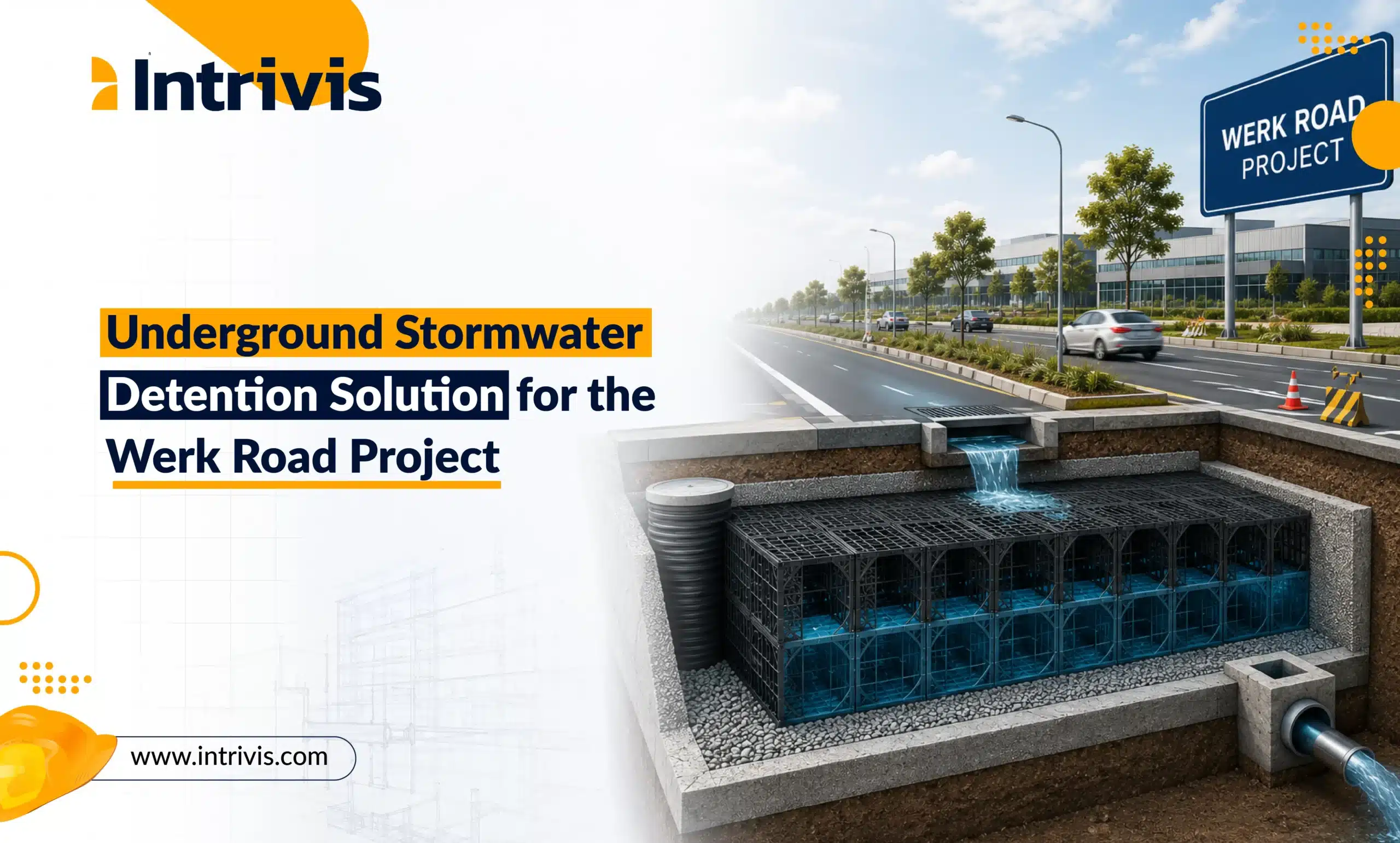
The civil engineering sector continues to face the dual pressures of regulatory compliance and efficient land use, especially on constrained sites. In modern practice, an Underground Stormwater Detention Solution can deliver the required post-development runoff control while preserving surface area for development. This case study demonstrates how Intrivis, a technology-enabled platform that coordinates distributed engineering workflows, supported a mid-sized Ohio-based engineering firm in designing and implementing a space-efficient detention strategy for the Werk Road Project in Hamilton County, balancing hydraulic performance with the preservation of developable land. The approach reflects industry guidance on detention design, including the principle that detention systems are intended to slow and temporarily hold runoff and release it at a controlled rate.
Client Background
The Werk Road Project involved a regional civil engineering consultant specializing in site development, infrastructure, and stormwater management in Ohio. The client operates in a regulated environment where post-development runoff must be controlled in accordance with local stormwater regulations, while land use efficiency remains a core project objective. To meet these needs, the client required assistance in coordinating distributed engineering workflows and connecting hydrologists, modelers, and CAD technicians with the in-house team through a time-zone-aligned, distributed collaboration model. The project site is in Hamilton County, an area noted for development pressure and the need to optimize land use to meet multiple programmatic objectives.
Problem Faced
The primary challenge was to provide the required detention capacity without dedicating a sizable surface pond that would erode development yield. The limited site area meant that a conventional above-ground basin would have consumed valuable land and potentially constrained the project’s development plan. In addition to capitalizing on space efficiency, the solution had to maintain regulatory compliance, ensure constructability within the existing footprint, and align with the project’s timeline. These constraints demanded a robust evaluation of detention strategies, including a careful comparison of underground options against traditional surface facilities. Industry practice supports underground strategies as viable solutions for space-limited sites, particularly where parking areas or roadways can accommodate detention infrastructure out of sight. The local regulatory framework also guides detention design to ensure that the post-development runoff is adequately stored and released in a controlled manner.
Client Quote
“The site’s limited area meant we had to preserve as much developable land as possible while still meeting detention requirements. The underground approach gave us the hydraulic capacity we needed without compromising the project’s program.”
This sentiment reflects the pragmatic value of space-efficient detention in constrained sites and the importance of aligning engineering delivery with project goals. The quote underscores the advantage of the Intrivis-enabled remote engineering workflow that can accelerate model iterations and coordinate with the design team to achieve this balance.
Solution Provided
The Intrivis-enabled delivery workflow conducted a comprehensive hydrology workflow to determine the detention storage required for the Werk Road site. The scope included hydrologic modeling and runoff analysis, calculation of the detention storage volume, evaluation of alternative stormwater strategies, and development of a space-efficient detention solution. Based on the site’s constraints and the storage requirements, the team proposed an underground detention system using detention pipes rather than a traditional surface basin. This approach captured the necessary storage volume beneath the site while preserving surface area for the development program.
The design integrated a distributed, platform-enabled collaboration to execute key tasks:
- Hydrologic modeling and storage-volume calculations to match local regulatory requirements.
- Alignment with existing utility corridors and vehicular load considerations to ensure constructability under parking and road spaces.
- An evaluation of alternative approaches, confirming that underground detention offered the most efficient balance of hydraulic performance, surface-area preservation, and constructability for this site.
Measurable Results
The underground detention solution delivered clear, quantified benefits that align with project objectives and industry benchmarks.
- Detention volume achieved: 100% of the required storage for post-development runoff, verified through detailed hydrologic analysis and system sizing.
- Surface-area preservation: approximately 50% of developable surface area remained available for the project’s development program, enabling a more flexible layout and better overall site utilization.
- Cost context: underground detention costs for commercial applications commonly range from $8.50 to $17.00 per cubic foot of storage, depending on system type and excavation rates. This project leveraged a space-efficient configuration that optimized the lower end of the cost spectrum for underground detention and minimized surface-area-related cost penalties.
- Time and risk efficiency: the Intrivis-enabled, distributed collaboration model enabled parallel design workflows, reducing the design phase and coordination overhead and mitigating the risk of schedule overruns associated with complex, space-constrained sites. This approach is consistent with industry practice that emphasizes coordinated, standards-aligned underground solutions to manage regulatory risk and project complexity.
- Compliance and outcomes: the underground solution satisfied local stormwater regulations while preserving the site’s development potential, reinforcing the value of integrating space-efficient detention with rigorous hydrologic analysis.
The Werk Road Project demonstrates how a well-executed underground detention strategy enabled by distributed, remote engineering resources can meet regulatory requirements, preserve surface area for development, and maintain project momentum.



