

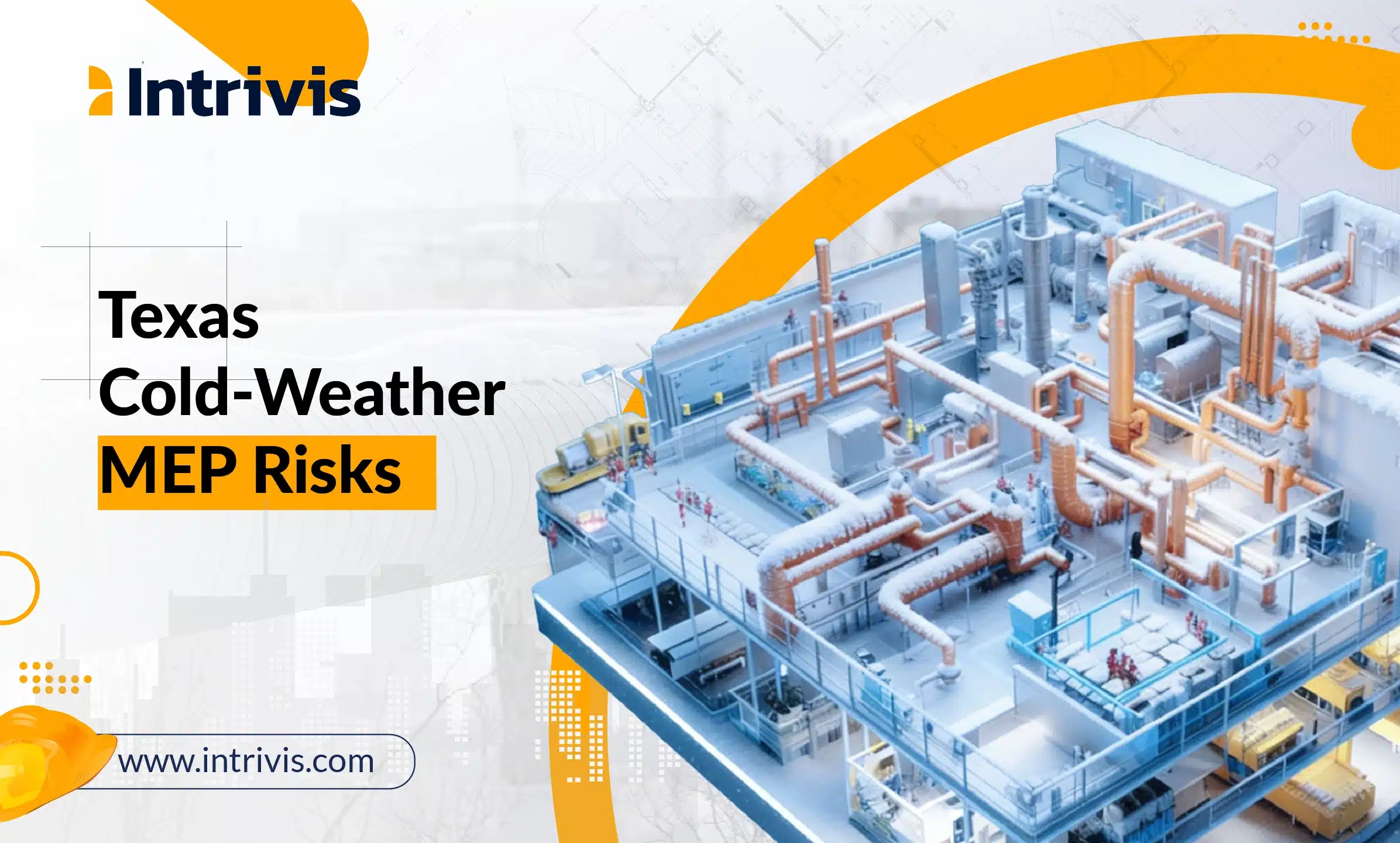
For decades, Texas MEP design has been a battle against heat and humidity. However, as “100-year freezes” become recurring events, the standard ASHRAE design temperatures are no longer enough to protect a firm’s work—or its reputation.
For mid-sized engineering firms, preventing MEP failures is not just a technical challenge; it is a project delivery, liability, and client trust issue. Understanding where failures occur and how to mitigate them can significantly improve resilience across projects.
Why Cold Weather Is a Growing MEP Risk in Texas
Texas has historically been a warm-climate design region, but recent winter storms have demonstrated that extreme cold is no longer an anomaly. Sudden temperature drops can impact plumbing, HVAC, electrical systems, and fire protection systems—especially when designs assume minimal freeze risk.
Common Cold-Weather MEP Risks Include:
- Frozen and burst pipes in plumbing and fire suppression systems
- HVAC system failures due to insufficient heating capacity or insulation
- Electrical disruptions affecting heating equipment and control systems
- Loss of system redundancy, leading to cascading failures during power outages
For engineering firms, these failures can trigger urgent redesigns, emergency client requests, and post-event remediation work.
Common Design Gaps That Lead to MEP Failures
Many cold-weather failures stem from design assumptions rather than execution errors. In warm-climate regions like Texas, MEP designs often prioritize cooling loads, energy efficiency, and cost optimization—sometimes at the expense of cold-weather resilience.
Typical gaps include:
- Inadequate pipe insulation and heat tracing
- Limited freeze protection in exposed mechanical spaces
- HVAC systems not sized for rare extreme cold scenarios
- Lack of redundancy in critical systems
- Coordination gaps between architectural, structural, and MEP designs
- Thermal bridging and improperly placed sensors
Addressing these gaps requires a proactive design mindset and cross-discipline coordination.
Practical Strategies to Prevent Cold-Weather MEP Failures
Engineering firms can take several practical steps to strengthen MEP designs against extreme cold events:
1. Reassess Freeze Protection Design Criteria
To prevent catastrophic failures, firms must shift from standard compliance to prescriptive freeze protection by adopting ASHRAE 99.9% or “Extreme Cell” design data for heating loads. This recalibration is critical for air-source heat pumps, which see a rapid drop in COP (Coefficient of Performance) as temperatures approach 0°F (-18°C). By mandating auxiliary electric heat kits and robust insulation for vulnerable systems, designers can bridge the gap between historical climate data and the reality of modern Texas winters, protecting both project performance and professional liability.
2. Enhance HVAC Cold-Weather Performance Planning
Heating capacity, control systems, and backup power integration should be reviewed for extreme cold scenarios. Designing for peak cold loads—even if rare—can prevent system-wide failures.
3. Improve System Redundancy and Resilience
Redundant heating systems, backup power for critical equipment, and fail-safe control strategies can significantly reduce risk during power disruptions.
4. Strengthen Cross-Discipline Coordination
Cold-weather resilience requires alignment between architectural enclosure design, structural detailing, and MEP systems. Early coordination reduces exposed components and improves system performance.
5. Conduct Cold-Weather Design Reviews
Periodic design reviews focused on extreme weather scenarios can identify vulnerabilities before construction. These reviews can be integrated into quality assurance workflows.
Engineering for Resilience: Traditional vs. Hardened Design
In the wake of recurring Texas freezes, the gap between “code-minimum” and “climate-resilient” has become a matter of professional liability. For firms looking to communicate the value of hardened systems to clients, this side-by-side comparison highlights why traditional warm-climate templates are no longer the safe bet.
| System | Traditional “Warm Climate” Design | Resilient “Hardened” Design |
|---|---|---|
| Piping | Standard fiberglass wrap; minimal heat trace. | High-R closed-cell insulation; monitored heat tracing. |
| HVAC | Sized for 99.6% heating days; no backup. | Sized for 99.9% data; auxiliary electric heat kits. |
| Automation | Basic occupancy-based controls. | Automated freeze-protection logic (e.g., pump flow monitoring). |
| Fire Protection | Dry systems only in obvious “cold” areas. | Redundant heating or glycol loops for interstitial spaces. |
Operational Strategies for Engineering Firms
Beyond technical design improvements, operational readiness plays a critical role in preventing MEP failures.
- Remote design workflows ensure teams can continue working during disruptions.
- Scalable design and drafting support helps firms respond to urgent redesign requests after extreme weather events.
- Standardized BIM and collaboration protocols improve coordination during compressed timelines.
Mid-sized firms, in particular, benefit from flexible capacity models that avoid overstaffing while maintaining responsiveness.
How Design Support Can Help
External design and drafting support partners can provide additional capacity for MEP modeling, coordination, documentation updates, and BIM support during peak demand or post-storm recovery phases. This allows internal teams to focus on client communication, technical oversight, and strategic decision-making.
Moving Toward Cold-Weather-Resilient Design in Texas
Extreme cold events are reshaping assumptions about climate risk in Texas. Engineering firms that proactively strengthen MEP design criteria, coordination workflows, and delivery capacity will be better positioned to protect clients, reduce liability, and maintain project timelines.
Intrivis supports engineering and design firms with flexible MEP design, drafting, and BIM assistance to help teams enhance system resilience and scale delivery during disruptions. If your firm is evaluating how to strengthen MEP design readiness for extreme weather, a short conversation can help assess current workflows and support options.



