

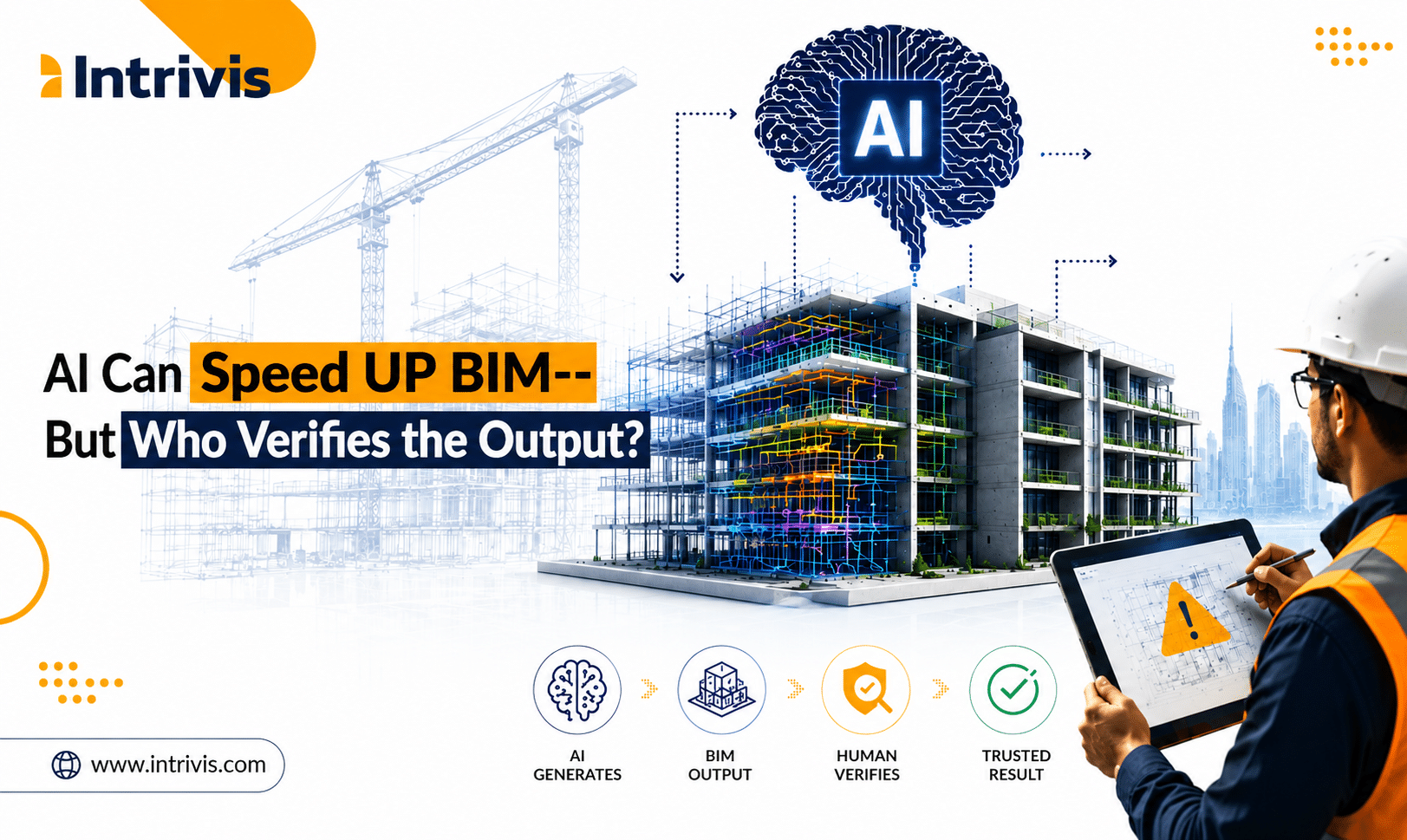
An AI engine can generate a fully routed MEP system or run a complex multi-discipline clash-detection report in less than two minutes. But when that model hits the field and a main duct collides with a structural beam, the AI isn’t the one paying for the $50,000 change order—you are.
This is the central paradox of the modern construction tech boom. We are rapidly transitioning from a world where drafting was the bottleneck to a world where verification is the bottleneck. AI can speed up BIM (Building Information Modeling) workflows at an astonishing rate, but it lacks the constructability logic, site context, and professional accountability required to sign off on a buildable set of drawings.
When the software moves faster than the human eye can track, how do you prevent subtle AI “hallucinations” from turning into devastating field errors?
The Illusion of Speed: Why AI “Exposure” Requires Human Oversight
With Autodesk embedding AI assistants directly into Revit and the Autodesk Construction Cloud, the speed of model generation has skyrocketed. In fact, reports indicate that architecture and engineering roles have an estimated 82% theoretical exposure to AI automation.
However, “exposure” to automation is not the same as autonomous execution.
When you automate first-pass modeling, clash detection, or Level of Development (LOD) compliance, you don’t eliminate Quality Assurance (QA). You simply push it down the pipeline.
- Plausible but Flawed Designs: AI algorithms are exceptionally good at finding geometric paths, but they don’t understand installation logic. An AI might route a conduit perfectly through a wall cavity on screen, completely ignoring the physical clearance a human electrician needs to actually install it.
- The Risk of “Subtle” Errors: Traditional human errors are often obvious—a missing pipe or an empty sheet. AI-generated errors, however, are highly plausible. They look correct at a glance, which actually makes them harder to spot during a rushed review.
- The Interoperability and Data Gap: A report by DowntoBid highlights that 68% of AEC firms struggle with software interoperability. When AI attempts to bridge these software gaps without clean, standardized data, it frequently misinterprets parameters, leading to broken coordination models.
The Reality Check: While IMAGINiT reports that 74% of AEC firms use AI to accelerate project delivery, the National Institute of Standards and Technology (NIST) and industry experts emphasize that AI is an assistant, not a decision-maker. Accountability for code compliance, structural integrity, and constructability remains 100% human.
The Hidden Cost of the “Verification Bottleneck”
Many firms adopt AI tools expecting to slash their drafting budgets, only to find their highly paid senior engineers spending double the time checking, correcting, and re-routing automated models.
If your team is saving 10 hours on drafting but spending an extra 12 hours squinting at screens to verify that the AI didn’t route a sanitary line through an elevator shaft, your net ROI is negative.
| BIM Workflow Stage | What AI Can Do | What Only Humans Can Verify |
| Clash Detection | Flags thousands of geometric interferences in seconds | Filters out “noise” and prioritizes real constructability issues |
| MEP Routing | Generates path options based on standard spacing | Ensures code compliance, valve accessibility, and ease of maintenance |
| LOD Compliance | Automatically flags missing parameters or unpopulated assets | Confirms the physical components match the specific structural intent |
| Drawing Production | Auto-populates sheets, callouts, and schedules | Signs off on the technical accuracy and legal liability of the submittals |
Striking the Balance: Technology Guided by Human Expertise
To survive and scale, modern construction firms must adopt a hybrid workflow: using AI to automate repetitive, data-heavy tasks, while relying on experienced BIM specialists to perform the high-level, critical verification.
The firms winning the highest-margin contracts are those that don’t rely blindly on automated scripts. Instead, they partner with dedicated, specialized engineering teams who know exactly how to audit, refine, and polish digital models before they ever reach the field.
This is where integrating a specialized partner like Intrivis becomes your greatest competitive advantage. We combine latest digital workflows with a rigorous, multi-layered human review process to deliver shop drawings and BIM coordination models that are not just fast, but flawless. By letting our expert engineers handle the complex verification, coordination, and drafting, you protect your firm from costly field rework, eliminate the verification bottleneck, and can confidently scale your operations without the burden of heavy overhead.


